


Neat Bar ProPRODUCT REVIEW
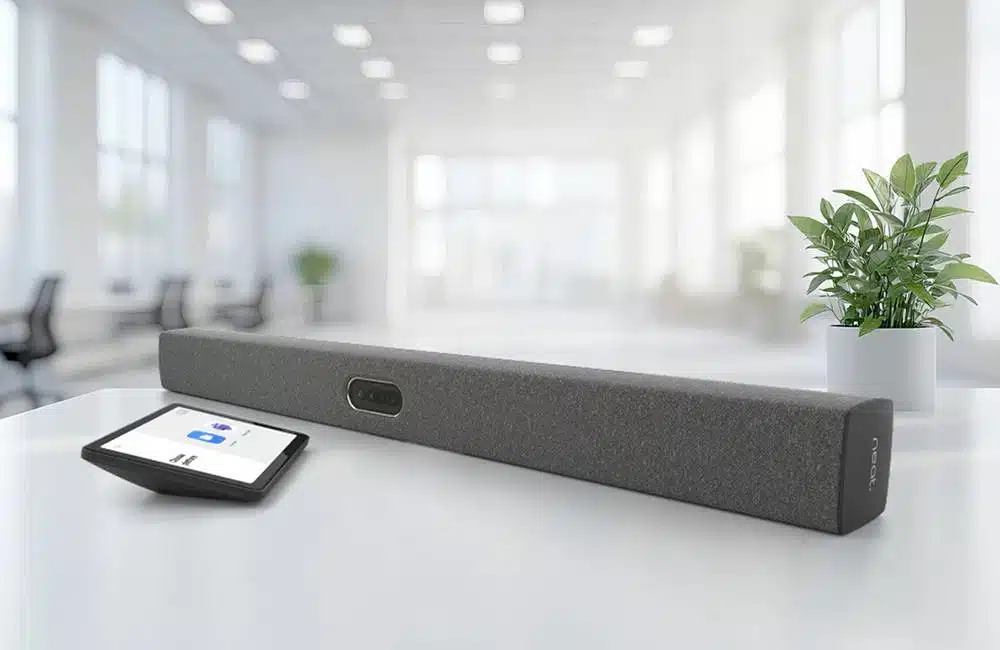
Neat Bar Pro
Covering larger spaces is inherently challenging with a video bar’s form factor. Built-in cameras have size limitations and are inflexible with positioning. Speakers and microphones in a video bar strain to hear and be heard by people at the head of the table. “All in one” tends to point away from expanding on any of these features. With the Neat Bar Pro, however, Neat tests all of these assumptions, using an ultra-high megapixel camera to address concerns over digital zoom and a sophisticated array of microphones to pick up voices up to 30 feet away. We reviewed the Neat Bar Pro bundled with a Neat Pad, as a complete Zoom Rooms solution.
Key Specifications
- Certifications Microsoft Teams, Zoom
- Appliance Mode Yes
- USB Mode Yes
- Built-in Video Fixed position 50 megapixel camera Supported resolutions: 1080p, 900p, 720p, SD at 30fps Content also supports 720p at 60fps Zoom: 16X digital Total room coverage: 113 degrees Horizontal
- Built-in Microphones 16-mic array, 4 tracking mics
- Built-in Speakers 3
- Displays supported 3
Use case for the Neat Bar Pro and Neat Pad
The Neat Bar Pro is ideal for a large room where running wires is undesirable, or where it is imperative to keep the table clear. Combined with the Neat Pad Pro, this package has everything an end user needs to deploy a Zoom or Microsoft Teams Room in a large space.
There is an array of 16 beamforming microphones that work with four tracking mics, producing a better result at 25 or 30 feet than we’ve seen with any other standalone video bar. Digital zoom is also implemented well with the Neat Bars, as it trims a 50-megapixel image to frame the person speaking.
Finally, the Neat Bar has a unique niche for Zoom Rooms: It can support three displays (Triple display configurations are not currently supported on Microsoft Teams).
Price Range
Bundled at $5,850, the Neat Bar Pro and Neat Pad are in the realm of premium video bar solutions aimed at larger applications. “Logitech’s a little cheaper,” said business development executive Ryan Malloy.
“Poly’s probably in that range … a Studio X series.” “It made me think of the (Logitech) Rally Bar itself, although this had a better pickup range,” project manager Jay Casey said. “Yealink’s much less expensive.”
Designer Duc Nguyen agreed, saying Logitech’s Rally family of products came to mind. “There’s not a huge gap between Logitech ($4998 MSRP for a Rally Bar and Tap) and (Neat Bar Pro),” she said.
Build Quality
The aesthetics and overall build quality of the Neat Bar Pro and Neat Pad were appealing to our team, including Duc, who studied design.
“It looks beautiful. Simple, but elegant,” Duc said. She had reservations about the sturdiness and shape of the speaker grilles. “It’s appealing,” Ryan added. “It’s modern. It’s sleek.” “I think it’s pretty good. It’s a solid build,” Jay said.
“The microphone was great, picking up from very far away. As far as the audio went, speaker volume – it definitely can get very loud for a big room.”
Installation experience
Jay explained that Neat’s video bars offer the simplicity the category is known for, though he critiqued the included TV mount.
“It’s a pretty standard video bar experience. The only negative I would say is that the mounts for the TVs are a little janky or loose. They would wiggle a lot.
If you nudge the TV, (the Neat Bar) would shake,” Jay said. “Other than that, they’re very simple to install. Easy to set up and use.”

Industry standards
The Neat Bar Pro does not support High Definition Copyright Protection (HDCP) via HDMI, which is standard practice to allow for meeting content to be recorded. Its HDMI outputs support all common resolutions up to 1080p, so users looking for full 4K would need another product.
Future audio expansion would use an Ethernet connection, a common option for data and networked audio. Neat has certified the Neat Bar Pro and Neat Pad for Zoom and Microsoft Teams.

User interface
Our team tested the Neat Bar Pro and Neat Pad in a Zoom Rooms environment, meaning Zoom was responsible for the core user-interface elements.
“The overall user experience is very intuitive,” Jay said, crediting the Zoom Rooms UI. “You can very quickly walk up and know how to change the volume, select different camera views,” he said.
Ryan found the “UI on the Neat Pad to be a bit cramped,” as compared to the Logitech Tap. “It’s almost cropped in,” he said. “I had a good experience using it,” Duc said.
Standout features
To our panelists, the Neat Bar Pro’s audio and video capabilities in a large space stood out. “One thing I think is really strong is the framing and tracking capabilities on this camera,” Ryan said, mentioning that other products could seem jumpy or too sluggish.
“It doesn’t over-compensate or under-compensate. It seems to do a really good job of following you around. I was pleasantly surprised with how efficiently it was able to keep pace as you moved across the room.”
“(The Neat Bar Pro) genuinely felt like it was following the speaker,” Jay said, echoing Ryan’s praise for the camera tracking. “A lot of times you see these systems, and if you move or start talking, it takes them a second to slowly pan over.”
“Obviously, I can tell that when you stand further away, it’s harder to hear, but I can tell that it’s still giving me a good result,” Duc said. She also praised the speaker tracking and wide viewing angle of the camera.
Reasons to buy
Neat Bar’s jam-packed set of features provided plenty of reasons for our team to recommend it, even compared to well-known brands.
“In terms of pure performance, as a piece of hardware, I think it’s really strong. I think it’s stronger than the (Logitech) Rally Bar. I think it’s probably stronger than the Poly and stronger than the Yealink as well,” Ryan said.
“For the price point, I think it’s a very solid product,” Jay said. “It’s simple to set up, simple to use, and it’s good quality,” Duc said she thought an end user might choose the Neat Bar for the design, which she found preferable to other video bars. “It doesn’t have a chunky camera,” she added.
Reasons to reconsider
While the features in the box are impressive, our Profound panel was disappointed with a lack of audio expandability and the price positioning of the Neat Bars and Neat Pad. “Not having Neat-ecosystem expansion microphones, I find to be a little weird,” Ryan said. “Having to go third-party (with a future update for expansion) limits your options.”
He also said customers might already have hardware from other well-established brands that would provide a more familiar experience. “Maybe if you have a bigger boardroom, I could see people at the far end of the table not having the best audio pickup.
At that point, you might want to go with something where you have mics on the table,” Jay said. Duc cited the total price point, as compared to mainstays like the Rally Bar, as a reason the Neat Bar Pro and Neat Pad might not be right for an end user.
Conclusion
For the price point, the Neat Bar Pro and Neat Pad deliver tons of tech and features for less than Poly’s top end, and slightly more than a Rally Bar with two added Mic Pods.
The Neat Bar Pro even offers some unique advantages, like support for three displays in Zoom Rooms and among the most capable microphones we’ve tested on a built-in video bar. Our Profound team loved the high-megapixel camera and strong execution of speaker tracking.
On the other hand, our panel noticed the limitations of the built-in audio at the extremes of the Neat Bar Pro’s 30-foot range, lack of audio expandability pending a future update, and a price point that may not make sense to an end user who doesn’t require some of the specific benchmarks that Neat Bars offer.
Check out our detailed scoring for the Neat Bar Pro and Neat Pad below.
Scores from our team
Frequently Asked Questions
Why does the Neat Bar Pro use a 50-megapixel camera if meetings are only displayed at up to 1080p?
The high-resolution camera gives the Neat Bar Pro more image data to work with before it crops, zooms, and frames the speaker. That’s important because digital zoom normally loses clarity as it zooms in. By starting with a 50-megapixel image, Neat Bar can frame people across a larger room while still producing a clean meeting image.
How does the Neat Bar Pro achieve the 30-foot audio pickup range without external table mics?
The system relies on a dense array of 16 beamforming microphones coupled with 4 dedicated tracking microphones. Instead of just listening globally, the hardware uses advanced algorithms to physically isolate and lock onto the acoustic signature of the speaker. However, because the sound follows the inverse-square law, acoustics at the strict 30-foot boundary will always naturally degrade compared to a seat right next to the bar.
Can we use the Neat Bar Pro with Zoom Rooms or Microsoft Teams?
Yes. The Neat Bar Pro is certified for both Zoom and Microsoft Teams, but the best choice depends on how your organization already meets. One important difference is display support. The Neat Bar can support three displays in Zoom Rooms, though triple display configurations are not currently supported on Microsoft Teams. If your room depends on multiple screens for people, content, and gallery views, that distinction is quite important.
Are there any practical implications to missing HDCP support?
The absence of HDCP is intentional and common in enterprise-grade AV gear. Because HDCP encrypts content to prevent unauthorized copying, omitting it ensures that local meeting presentations, slides, and shared documents can be freely captured by network recorders, media servers, or streaming codecs during a live video conference.