




Most Recent Product Review
Neat Bar Pro
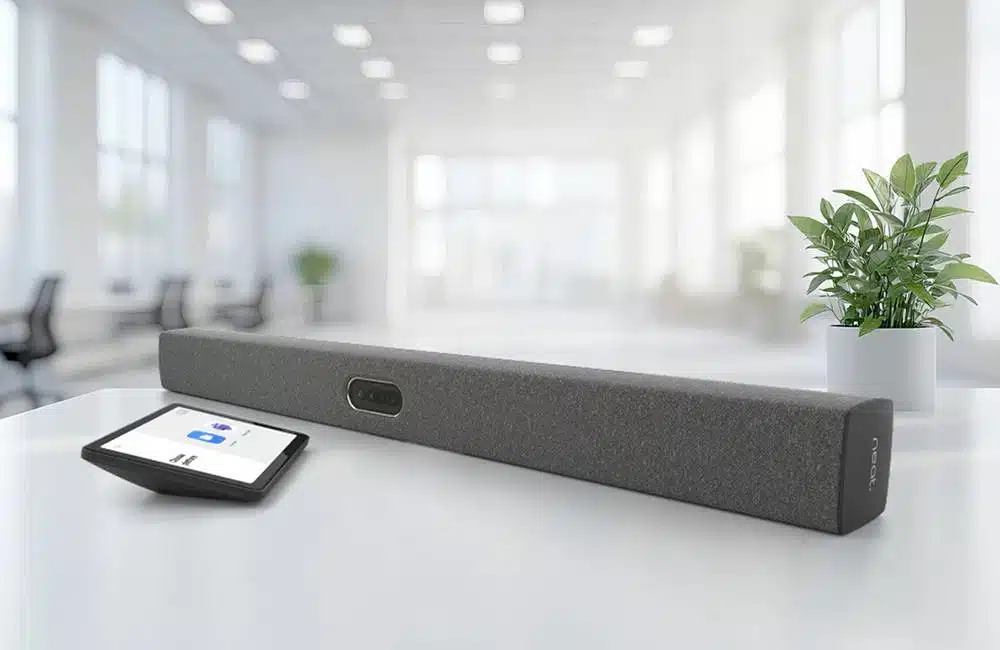
Covering larger spaces is inherently challenging with a video bar’s form factor. Built-in cameras have size limitations and are inflexible with positioning. Speakers and microphones in a video bar strain to hear and be heard by people at the head of the table. “All in one” tends to point away from expanding on any of these features. With the Neat Bar Pro, however, Neat tests all of these assumptions, using an ultra-high megapixel camera to address concerns over digital zoom and a sophisticated array of microphones to pick up voices up to 30 feet away. We reviewed the Neat Bar Pro bundled with a Neat Pad, as a complete Zoom Rooms solution.
Common AV Issues
Common AV Issue
Voices on Conference Calls Sound Hollow or Thin

Common AV Issue
Excessive Table Noise

Common AV Issue
Laptop Unable to Share Video to Display or Video Conference
Common AV Issue
Display Doesn’t Power On/Off Each Day
Common AV Issue
Voice Volume from Remote Party is Too Low or Too High

Voices on Conference Calls Sound Hollow or Thin
Are the microphones in the space too far from speakers?
- One common reason for conference calls sounding hollow or thin would be the distance between the microphones and the person speaking. This allows ambient room noise to be captured rather than a focused audio of just the speaker persons’ voice. For tables, we would recommend a distance no greater than 3-6’ from each person to the placement of the microphone.
- Another common reason for hollow or thin sounding Video Conference feeds is that the levels of the microphones are not set high enough to provide an adequate output level from the Sound Processing Device to the Compute or the appliance device.
Excessive Table Noise
Too much table noise or background noise is a common complaint from video conference users. There are many circumstances that can cause this, so we will cover a few of the basics.
- The quickest solution for this is to make sure that any kind of Noise Reduction options are turned on in the Video Conferencing Application you are using. For Example, in a Teams room you can accomplish this by going into the audio settings and enabling Noise Reduction. The Services have gotten much better at canceling these kinds of noises out.
- If you have these settings on and are still experiencing too much table noise it’s time to look at the style of microphones being used and the placement. If possible Microphones should be directed towards the users speaking, and not aimed towards table level.
- Finally if you have a DSP (Digital Sound Processor) installed a consultation may be best to evaluate the more advanced setup and confirm all levels are set appropriately to best avoid this issue.
Laptop Unable to Share Video to Display or Video Conference
Not being able to share content into a Presentation or video conference causes a big point of frustration for all users! Here are some quick tips to get you back on track.
- Make sure automatic sharing is enabled in your choice of conferencing software. This saves you from having to press the share now button!
- If you are using a hardwired solution and the HDMI doesn’t work, make sure the connection is plugged in firmly to your device, and into the input port
- If you are using wireless sharing make sure you have the right passcode!
- Finally confirm that all devices you are using have the most up to date firmware, and that you are using adapters that are certified for your device
Display Doesn’t Power On/Off Each Day
Microsoft Teams and Zoom Rooms provide an easy way to turn your Displays On and Off that match your business hours. Some reasons that may not work are listed below.
- Confirm the Schedules are set and applied on a per room basis in the Administrator portals. Just because you set the hours doesn’t automatically apply to each room.
- Confirm that your Displays support HDMI control, and that HDMI Control is enabled in your Device. These settings are manufacturer specific, for example, LG calls them Simplink, Samsung is Anynet+, and Sony is Bravia Link.
- Finally make sure that the Video Conference Devices have the correct time zone set so that it matches your schedule.
Voice Volume from Remote Party is Too Low or Too High
- A common reason for the Remote Party Volume being too low or high the default volume is set either too low or high in the Teams or Zoom Portal. To resolve this you should find an appropriate level, and have your Teams or Zoom admin set the default level to match.
- If you have a speaker bar, or ceiling speakers you will also want to make sure that the audio device you have selected is utilizing those speakers rather than the Display in the room. Typically the Selection to reflect these options will have Echo Canceling Speakerphone for most devices.
Industry
Problems
There are a lot of Audio Video companies out there. It’s up to you to choose the one that fits your project best, even if that is not us.
In our 30 years in the industry and 20+ years in business we have seen a lot of different approaches from other companies. This has served to mold and reinforce why we are different in our approach from so many others.
So, let us share some of those differences. If you agree with our approach, then perhaps we are the best fit for your next project!
Competing for the Lower Price results in Lowest Quality
We often see Audio Video companies that are cashflow driven and operate in a mode to “just keep the business running”. These companies win a lot of projects because they are willing to quote the lowest price and get cash in the door to meet basic financial obligations.
You would think this would be great for the customer, because you’re getting a lower quote, right? But it is exactly like the saying goes, “you get what you pay for”. Think about it. If the company quoting you that lower cost is barely making any money, that creates poor outcomes, like these:
They often “win” many projects (and take them due to cash needs) but then they don’t have ample knowledgeable staff to complete the projects. They don’t have the funds to hire proper staff and compete in the marketplace. Heck, even if they did, keeping up with the project volume alone creates a training deficit.
You tend to get no or low- knowledge workers arriving at your project, attempting to fumble through it. If you are seeing a Project Manager onsite babysitting the technicians…it is not because they are trying to provide extra interaction. It is because there is such low confidence in the technicians.
The volume of projects they must sustain to keep financially stable means many competing customer deadlines. It is a sad but common practice that we hear in our industry of employees being sent to job sites just so the company can say “someone was there” to meet the schedule – but that employee doesn’t know how to do any project work. They are a placeholder.
Have you ever had a project where the audio video technician arrived and was surprised by something “unknown”? This is due to lack of planning, site surveying, and attention to detail. Another impact from lesser margins converting to lesser talent.
Low quality product substitutions. In our next section we will discuss the difference in product qualities when they are “downgraded”. But in smaller companies a common tactic is to swap commercial products for consumer products and just assume it will all work the same. You pay less for consumer products because they don’t have to operate at the same non-stop usage levels, consistency, power tolerances, etc. This just results in failing devices and downtime for you as the customer in the end. Not to mention lack of warranty.
Lastly, a customer should be considering Day 2 support. What is Day 2 support? That is when a project is completed for all intents and purposes, but something minor comes up that needs a service call. When projects are quoted with minimal chance of profitability, return visits are instantly a huge problem for audio video companies that quote this way. They simply cannot afford to return to fix a problem that comes up. This can often play out in Change Orders that they try to get approved along the way, or delays in support so they can focus on the next project instead. Day 2 support is not uncommon, and it’s honestly not a bad sign by itself…but the way it’s handled is important.
So how do we, Profound Technologies, address these issues?
That’s right, we choose you as much as you choose us. We want to make sure our expertise matches what you are looking for. We also want to make sure that we don’t have to compromise the quality of the work we provide due to constraints that we cannot overcome. At the end of the day, we want to provide a solution that we are confident will work and we can be proud of.
The most obvious constraint on projects is always price. How much is in the budget? We always quote a price that we believe to be reasonable for the solution needed and that we can afford to take on. We consider the details like quality of products, warranty, talent, day 2 support, and maintaining a roster of projects that we know we can excel at.
A staff of 10 A-Team players is more effective than a staff of 30 C-Team players. Another way to think of it is, how many technicians does it take to screw in a light bulb? It’s really that easy. We don’t waste our time hiring large numbers of team members to make up for the lack of competency. We focus on doing bigger things with fewer more talented people. Our team is fantastic!
We are accountable to our customers, our staff, and ourselves to succeed. That means proper planning and management for continued growth. With a ‘hands on the wheel’ approach. That’s a simple thing to say, but less so in practice. However, we have always been intentional about this and some businesses are not.
Commercial Environment
Why Managed Services Outperform Ad-Hoc Solutions
When it comes to maintaining tech infrastructure, the choice between managed services and ad-hoc solutions is critical. While ad-hoc models might seem cost-effective upfront, managed services provide greater value and reliability in the long run.
Managed services address issues before they disrupt operations, thanks to continuous monitoring. Ad-hoc models only respond after something goes wrong, often leading to costly delays and downtime.
Ad-hoc providers can vary in quality, while managed services ensure skilled professionals familiar with your systems handle every task. This consistency boosts efficiency and reduces repeat issues.
Ad-hoc services may save money initially, but unpredictable expenses from emergencies and downtime can add up. Managed services offer fixed monthly fees and preventative maintenance, minimizing costly surprises.
Ad-hoc providers often struggle with follow-ups, while managed services include ongoing support, ensuring quick resolutions for any future issues.
Managed services help businesses stay ahead with updates and commercial-grade equipment designed for reliability. Ad-hoc models risk frequent failures by using less robust solutions.
For businesses seeking dependable performance and predictable costs, managed services are the smarter choice. They reduce risks, deliver peace of mind, and prepare your operations for the future.

Blog
and our industry has been up to.